A few years ago, buying on Dwarka Expressway felt like a risky decision. Today, the situation has completely changed.
The expressway is fully operational, property prices have risen sharply, and demand continues to grow across major sectors. What was once seen as a future opportunity has now become one of Gurgaon’s fastest-growing real estate corridors.
From working professionals and families to NRIs and investors, buyers across segments are choosing Dwarka Expressway for its strong connectivity, modern developments, and better long-term value compared to many established locations.
1. Why Dwarka Expressway Feels Different from Other Gurgaon Corridors
Gurgaon has grown in layers. Old Gurgaon — DLF phases, MG Road, Golf Course Road — was built fast, often without much planning. Traffic bottlenecks, mixed land use, narrow internal roads, and uncoordinated development are the price you pay for buying in those established zones.
Dwarka Expressway was always designed differently.
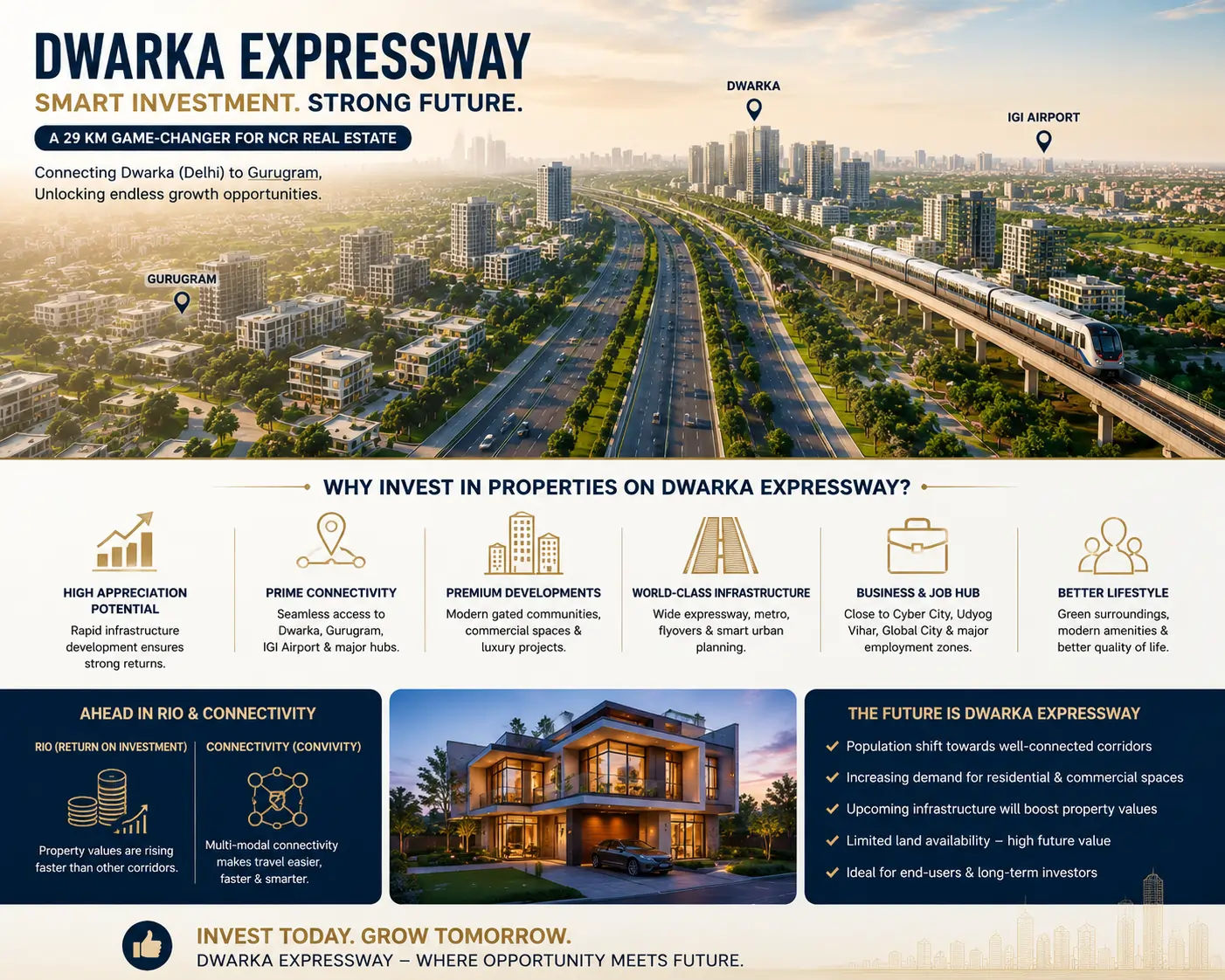
The expressway itself spans 29 kilometres, features 16 lanes (including service lanes), 20 flyovers, 2 rail overbridges, and 11 vehicle underpasses. That's not standard road infrastructure — that's a city spine.
The sectors alongside it — mainly 84 through 114 — were planned under structured layouts. Many are low-density. Gated communities here aren't crammed one next to the other. You actually get green buffers, wider internal roads, and setbacks that older Gurgaon doesn't have.
For a buyer who's spent time in Sushant Lok or even parts of DLF Phase 4, the difference is noticeable within minutes of driving through. Less clutter. More breathing room. The kind of layout where a township actually feels like a township.
2. The Connectivity Advantage That Changes Daily Life
Connectivity is always listed in real estate brochures, so let's talk about what it actually means for the person living there.
The airport commute. For anyone who travels frequently — or whose family does — IGI Airport, sitting just 8 to 15 minutes away from key sectors on Dwarka Expressway, is a genuine lifestyle upgrade. Properties near airports in global cities consistently command a premium, and Delhi NCR is no exception.
The Delhi access. The expressway connects directly to Shiv Murti in Dwarka, Delhi, via a signal-free corridor. A commute that used to take 70-80 minutes on the old Palam Vihar route can now take under 30 minutes. That's not a marginal improvement — it's time given back to your evenings.
Cyber City and NH-48. For the massive working population based in Gurgaon's tech and financial hubs, the expressway feeds into NH-48, making Cyber City reachable without navigating Old Gurgaon's chokepoints.
What's coming next? A 15.2 km metro corridor from Millennium City Centre to Cyber City, including a spur line towards Dwarka Expressway, is confirmed and expected to be operational by 2026–27. When metro connectivity activates, the last remaining friction in daily commuting largely disappears — and that historically triggers another round of price movement.
3. Why Dwarka Expressway Works for Both Affordable and Luxury Buyers
This is the part that makes this corridor genuinely unusual. Most real estate zones in Gurgaon tilt one way — either they're mass-market, or they're premium. Dwarka Expressway somehow manages both, and the segments don't really compete with each other because they occupy different sectors.
For Affordable Buyers
If you're comparing what ₹70 lakh to ₹1.5 crore gets you in Delhi versus here, the arithmetic shifts dramatically in favour of Dwarka Expressway.
In Delhi, that budget gets you an ageing 2BHK in a building with no gym, no green space, and parking that's an argument waiting to happen. On Dwarka Expressway — particularly in sectors like 37D, 99, 102, and 103 — the same budget can get you a newer apartment in a gated community with amenities your Delhi counterpart would consider luxury.
The affordable zone also carries real appreciation potential. Sector 37D, for instance, has been flagged by multiple analysts as an entry-point sector with strong upside tied to social infrastructure growth. Early buyers in similar sectors a decade ago have seen returns that look implausible on paper.
For Luxury Buyers
Sectors 111, 113, and 114 — at the Delhi border end of the expressway — are where the premium conversation is happening.
These aren't just expensive apartments. You're looking at branded residences managed by international hotel groups, private elevator lobbies, concierge services, golf-landscaped communities, and homes that are genuinely designed around lifestyle rather than just square footage.
Projects like M3M Mansion, Elan The Presidential, Whiteland Westin Residences, and TARC Tripundra have set a new benchmark for what luxury means in this part of Gurgaon. And crucially, as of 2026, the price per square foot in Sectors 113–114 (roughly ₹15,000 to ₹18,000) still sits well below Golf Course Road (₹14,000–₹35,000) or DLF Phase 1-5 (₹25,000–₹45,000+). That spread is what institutional investors call a price arbitrage window.
If you’re exploring upcoming premium developments in Sector 63A Gurgaon, this guide will help you discover the projects worth considering.
4. Why First-Time Homebuyers Are Showing Serious Interest
Buying your first home is equal parts excitement and anxiety. You're making the biggest financial commitment of your life, often stretching your budget, and trying to make a decision that has to work for the next 15–20 years.
Dwarka Expressway is speaking to that anxiety better than most corridors right now.
Modern township living. These aren't isolated buildings. The newer projects here come with functional clubhouses, children's play areas, jogging tracks, and power backup as standard. For someone upgrading from a flat in Delhi or an older Gurgaon sector, the quality jump is immediate.
Schools and hospitals are improving. Social infrastructure — the part real estate developers always promise but rarely deliver on time — is genuinely arriving here. Good schools, clinics, and hospitals are active in and around Sectors 102, 104, 108, and 109. This matters enormously for families with children or elderly parents.
Payment flexibility. Most under-construction projects offer construction-linked payment plans, and some developers are doing possession-linked schemes. For a first-time buyer managing a home loan alongside rent, this structure makes the transition more manageable.
Future growth confidence. Nobody wants to buy into a location that stagnates. With the metro extension confirmed, Global City development underway, and commercial hubs maturing, Dwarka Expressway gives first-time buyers something rare: the feeling that their purchase is going into a story that hasn't fully played out yet.
5. The Infrastructure Boom and What It Actually Does to Property Demand
It's easy to list infrastructure projects. It's more useful to explain what each one means for the ground reality.
The expressway completion (2024–25). This was the single biggest catalyst. For years, buyers stayed away because of uncertainty around delivery. Prime Minister Modi's inauguration of the 19 km Gurugram stretch in March 2024, followed by full operationalisation in 2025, removed that hesitation permanently. Property prices responded immediately — Q4 2024 saw a 58% year-on-year surge, the highest appreciation of any residential corridor in India during that period.
Global City. Haryana's most ambitious urban development project — a 1,000-acre international township — sits adjacent to Dwarka Expressway. When it matures, it will add residential, commercial, hospitality, and institutional demand at a scale that changes the micro-market fundamentally.
The Diplomatic Enclave II proximity. Several sectors near the Delhi border sit close to where Diplomatic Enclave II is planned. Demand from embassy staff, diplomats, and the supporting services ecosystem will be a consistent premium driver.
Commercial hubs already active. M3M IFC and DLF Downtown are operational. Retail, office, and mixed-use developments are live. When you have commercial activity generating employment and foot traffic, residential demand isn't speculative — it's structural.
Toll relocation. The Kherki Daula toll has been one of the most discussed friction points for Dwarka Expressway residents. Its planned relocation to Pachgaon is expected by early 2026, which will ease daily commuting and remove one of the last practical complaints about living on the corridor.
6. Why Investors Still See Long-Term Potential Here
Let's be honest about something: some real estate corridors get hyped up and plateau. The question with Dwarka Expressway isn't whether it has grown — it has, dramatically — but whether the growth thesis still holds for someone entering now.
The answer, with some nuance, is yes.
Property prices here doubled in four years, and flat rates appreciated over 211% across a five-year period. That cycle is not repeating at the same velocity. Anyone expecting that kind of return in the next five years is likely overoptimistic.
But the next phase of growth has real structural drivers:
Metro connectivity will open up the corridor to a renter and buyer base currently priced out of transit-connected zones
Supply-demand imbalance in premium sectors: luxury launches in 2025–26 are seeing 40–60% inventory absorption in early phases, a booking pace that reflects genuine demand
Rental yields are rising, especially near Sectors 109–113, where airport and commercial proximity create a consistent tenant base of corporate professionals and NRIs
NRI attention has visibly increased — and NRI buyers tend to target well-connected, brand-name projects in growth corridors, exactly what Dwarka Expressway now offers
The investment window isn't as wide open as 2019–2021. But it's not closed either. The corridor has matured into a market that rewards strategy over speculation.
7. Which Sectors on Dwarka Expressway Are Getting Maximum Attention?
Not all sectors are equal, and buying in the wrong zone can mean waiting longer for returns or dealing with underdeveloped social infrastructure. Here's an honest breakdown:
Sectors 113 & 114 (Delhi border premium) are the most sought-after addresses right now. Direct Delhi access, luxury cluster development, and the highest price points — ₹15,000 to ₹18,000 per sq ft and above. Best for luxury buyers and long-term investors chasing spread compression against Golf Course Road pricing.
Sector 111 Balanced entry point between premium and transitional. TARC Tripundra and M3M Crown are landmark projects here. Prices in the ₹15,000–₹17,500 per sq ft range. Good for buyers who want a premium without paying peak-border pricing.
Sector 106 Home to Elan The Presidential, Godrej Meridien. Established project base, relatively mature social infrastructure, strong brand credentials. A reliable mid-to-premium sector for both end-users and investors.
Sector 108 Sobha City's 39-acre integrated township makes this sector stand out for buyers who value a completed, functioning community rather than a project still being built around them.
Sectors 102–104 Mid-segment sweet spot. Multiple gated communities with modern amenities at more accessible prices. Good for first-time buyers stepping up, and for investors looking at rental yield rather than pure capital appreciation.
Sector 37D The affordable entry point on the corridor. Signature Global has active projects here. Prices are lower, appreciation potential over 3–5 years is solid, and for buyers who need a foot in the door without stretching budgets, this is worth serious consideration.
8. Challenges Buyers Should Know Before Investing
A balanced article has to include this section, and any agent who skips it isn't doing you a service.
Social infrastructure is still uneven. The sectors closer to Kherki Daula — 84, 85, 88A — are more raw. Schools, hospitals, and daily convenience are improving, but not yet at the level of Sectors 102–113. If you're an end-user buying for immediate livelihood, this matters.
Some projects have delivery history concerns. Not every developer operating on this corridor has a clean track record. Before committing, check RERA registrations, construction progress, and look up buyer forums for that specific project — not just the developer's branding.
Luxury density is increasing. Multiple luxury projects launching in 2026–27 means the premium segment will face supply competition. For resale investors in the upper segment, absorption timelines matter, and not every luxury unit will command the same appreciation.
Price jump risks. Parts of the corridor — especially Sectors 113–114 — have already priced in a significant portion of near-term positive news. If you're entering at current prices expecting Golf Course Road-level returns in 3 years, the math may disappoint.
Liquidity is lower in far sectors. Sectors 84 and 85 offer attractive entry prices, but the resale markets there are thinner. If you need to exit quickly, selling could take longer.
None of these is a deal-breaker. They're just the kind of nuances a genuine buyer needs to factor in.
9. Who Should Consider Buying on Dwarka Expressway in 2026?
First-time buyers with a budget of ₹70 lakh to ₹1.5 crore — Sectors 37D, 99, 102, and 103 offer the best combination of modern amenities, entry pricing, and future growth potential. Focus on completed or near-completion projects from reputable developers.
Families looking for long-term residence — Sectors 102–108, particularly around established townships like Sobha City, offer the social infrastructure (schools, hospitals, green space) that makes living here genuinely comfortable.
Luxury buyers with a budget of ₹3 crore and above — Sectors 111, 113, and 114 are the right hunting ground. The pricing arbitrage against central Gurgaon still exists, and the projects here are genuinely world-class.
Investors focused on rental income — Sectors 109–113 near the airport and commercial zones generate consistent rental demand from corporate tenants. Expected yields are improving as occupancy in completed projects rises.
NRIs looking for a trusted asset in India — Brand-name projects on the expressway — Sobha, M3M, Godrej, BPTP, Signature Global — carry the kind of developer credibility that makes remote purchase decisions less risky. Airport proximity is also a practical plus for frequent visits.
Mid-range investors with a 5-year horizon — Sector 111 and selective projects in 102–106 offer the most balanced risk-adjusted proposition. Not the cheapest entry, but not peak pricing either.
Final Verdict: More Than Just Hype
Dwarka Expressway has earned its current status through something that most real estate narratives in India don't survive: actually delivering on the infrastructure promise.
The expressway is built. The metro is confirmed. Commercial activity is live. And unlike corridors that were hyped prematurely — where buyers spent years looking at construction sites — the physical transformation here is visible and verifiable.
That said, this isn't a simple buy-anything-here story anymore. The corridor has matured. The easy appreciation has happened. What remains is a market where smart sector selection, project-level due diligence, and realistic timelines determine whether you get a good outcome.
For the buyer who does that homework — who understands the difference between Sector 37D and Sector 113, who checks RERA before signing, and who buys with a clear purpose (end-use, rental, or long-term capital) — Dwarka Expressway in 2026 is one of the strongest residential propositions in Gurgaon.
The urban story here is still being written. The people who understand that tend to make better real estate decisions.